Materials

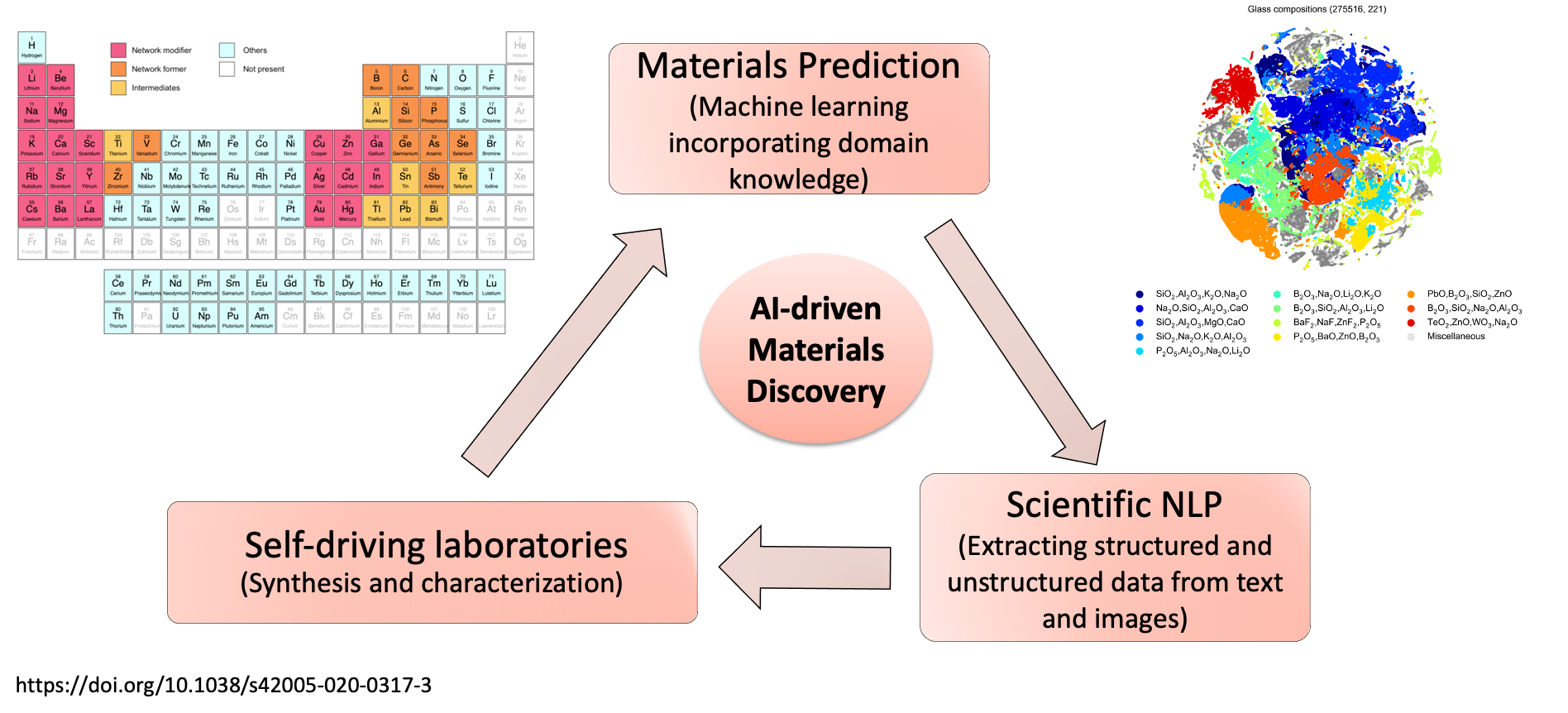
The progress of human society has been closely linked with the develeopment of materials. This is exemplified by different ages in civilization: the stone age, bronze age and iron age. Traditional materials design and discovery were based on expert knowledge, intuitions, empirical models, and Edisonian trial-and-error approach. This approach has several deficiencies. Specifically, the approach is (i) time-consuming, (ii) expensive, (iii) not failure-proof, (iv) useful for simple materials with a limited number of components. To address the ever-increasing demands for novel materials, a disruptive paradigm, reducing the design-to-deploy period to approximately five years, needs to be developed. At ScAI, we employ an artificial intelligence (AI)-driven materials discovery paradigm that can accelerate materials discovery and allow knowledge dissemination. The proposed framework is highly multidisciplinary, involving machine learning, materials science, natural language processing, robotics, and other relevant domains. The primary focus will be to provide a platform offering solutions to industry and academia on materials discovery, design, and expert knowledge for various applications such as energy, medical, agricultural, defense, and aerospace sectors, and even materials for AI. Ultimately, this proposal aims to develop a framework that "democratizes materials discovery using AI."

Impact Areas

AI-Driven Material
Discovery
NLP and Data Mining for
Materials
Self-driving
Laboratories
Graph Networks for Materials Modeling

Faculty Members Currently ​​​​​​​Involved

Jayadeva
Mausam
N. M. Anoop Krishnan
Nitya Nand Gosvami
Sayan Ranu
Souvik Chakraborty

Key Publications

  • Jindal, A., Gupta, P., Jayadeva, and Sengupta, D., 2018. Discovery of rare cells from voluminous single-cell expression data. Nature communications, 9(1), pp.1-9.
  • Ravinder, R., Sridhara, K.H., Bishnoi, S., Grover, H.S., Bauchy, M., Kodamana, H., and Krishnan, N. M. A., 2020. Deep learning aided rational design of oxide glasses. Materials Horizons, 7(7), pp.1819-1827.
  • MGoswami, S., Anitescu, C., Chakraborty, S. and Rabczuk, T., 2020. Transfer learning enhanced physics informed neural network for phase-field modeling of fracture. Theoretical and Applied Fracture Mechanics, 106, p.102447.
  • Ranu, S. and Singh, A.K., 2009. Mining statistically significant molecular substructures for efficient molecular classification. Journal of chemical information and modeling, 49(11), pp.2537-2550.
  • Bhowmik, D., Saxena, U., Dankar, A., Verma, A., Kaushik, D., Chatterjee, S. and Singh, U., 2019. On-chip learning for domain wall synapse based Fully Connected Neural Network. Journal of Magnetism and Magnetic Materials, 489, p.165434.
  • Bishnoi, S., Singh, S., Ravinder, R., Bauchy, M., Gosvami, N.N., Kodamana, H. and Krishnan, N.A., 2019. Predicting Young’s modulus of oxide glasses with sparse datasets using machine learning. Journal of Non-Crystalline Solids, 524, p.119643.