

The Fourth Industrial Revolution (or Industry 4.0) is the ongoing automation of traditional manufacturing and industrial practices. It majorly involves large-scale machine-to-machine communication and the internet of things (IoT) integrated for increased automation, improved communication and monitoring, and diagnosis without the need for human intervention. India as a country at the cusp of this transition.In the era of Industry 4.0, it is envisaged that highly intelligent connected industrial systems create a fully digital value chain. On the one hand industrial operations are targeting for operational profits, on the other hand the operations should be safe, efficient and environmental benign.
The broad AI tools are employed for the deep learning, graph mining, reinforcement learning, and surrogate models-based optimization. Some of the key applications under consideration are oil and gas, nuclear reactors and industrial water networks.
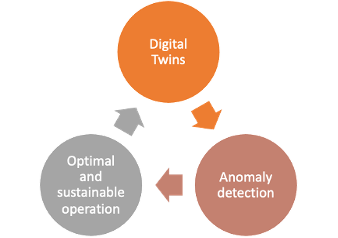
Current Focus
Digital Twins
Digital twin is an integrated multi-physics, multi-scale, data driven models that enables simulation of a system and uses the best available physical models, sensor updates, etc. It is the AI driven replica of the process that leverage full strength of archived sensor data. However, a key technical challenge here is the variety of the data, which may be discrete, continuous, sequential.
Intelligent and Sustainable
Operation
Here, we employ previously developed digital twins for AI-driven optimal decision making for improving the efficiency, and de-bottlenecking the operation. A key proposal here to factor in the sustainability to be factored in accounting for less wastage (lean production), less emissions (green production). To achieve this we envisage to solve a multi-objective optimization problem honouring various constraints.


Anomaly Detection
This ensures AI-driven guidance for safe operation employing digital twins. Here, the digital twin model serves as the null model. We are intended to identify anomalous signatures much before a potential event that is a potential manifestation of the networked effect of sub-components. Causal inference between multiple sub-units will also be evaluated. This step will aid in the sensor network design or retrofitting for efficient information processing.
Impact Areas
Faculty Members Currently Involved






Key Publications
- Saxena, N., Tiwari, A., Sonawat, D., Kodamana, H. and Rathore., A. S., 2020. Reinforcement Learning based Optimization of Process Chromatography for Continuous Processing of Biopharmaceuticals. Chemical Engineering Science.
- Fang, M., Kodamana, H. and Huang, B., 2019. Real-time Mode Diagnosis for Processes with Multiple Operating Conditions Using Switching Conditional Random Fields. IEEE Transactions on Industrial Electronics
- Chakraborty, S. and Adhikari, S. (2021). Machine learning based digital twin for dynamical systems with multiple time-scales, Computers and Structures, 243, 106410.
- Shaurya Shriyam, and Satyandra K. Gupta, "Incorporation of Contingency Tasks in Task Allocation for Multi-robot Teams", Accepted in IEEE Transactions on Automation Science and Engineering, 2019.
- Banerjee, P., Yawalkar, P. and Ranu, S., 2016, August. Mantra: a scalable approach to mining temporally anomalous sub-trajectories. In Proceedings of the 22nd ACM SIGKDD International Conference on Knowledge Discovery and Data Mining (pp. 1415-1424).
- Arnob Ghosh, Vaneet Aggarwal, and Hong Wan, "Strategic Prosumers: How to set prices in the Tiered Electric Market?", in IEEE Transactions on Industrial Informatics, August 2019, vol. 15, no. 8, pp.4469–4480