

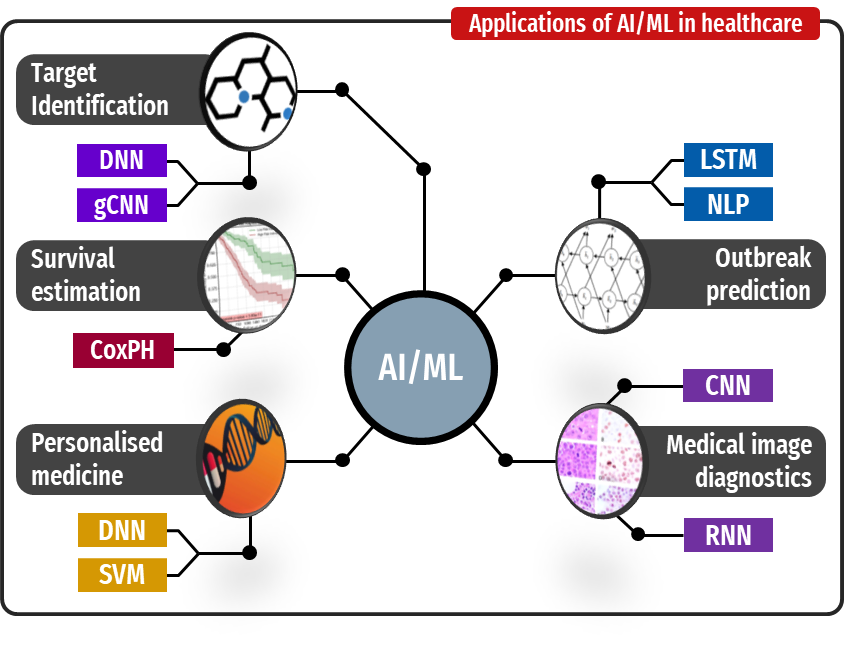
Overall healthcare activity has been categorized
into following
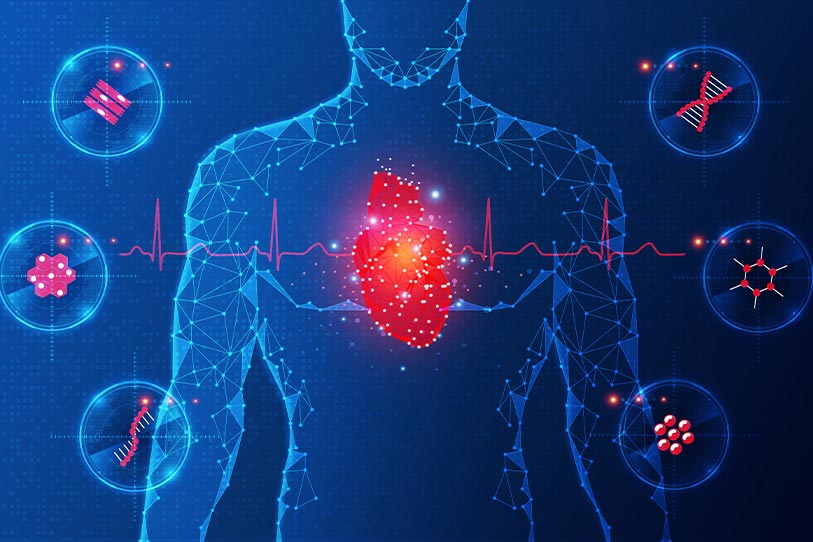
Diagnosis & Prognosis
Under this subvertical ongoing and future activities include AI applications towards diagnostic interpretation of health and subsequent prognosis towards radiological, pathological and cytological data, in general longitudinal, time series and genomic sequence. Active collaboration is being pursued with National Cancer Institute, ILBS, AIIMS New Delhi, PGI Chandigarh and other renowned research institutes across the country.
Therapeutics and Intervention
The group under this subvertical is engaged in active research towards cognitive/neuro robotics, smart prosthesis, dedicated AI chip for fast computation. Many high value projects are being pursued and the group intends to engage a wide pool of faculties with varied skill sets for system level engineering in this direction. Another research direction where the school of AI intends to contribute is surgical planning and simulation, where vision guided surgical simulation coupled with mixed reality can help doctors develop cutting edge technology driven intervention techniques.

Genomic & Personalized Medicine
AI applications towards genomics is an important field of research.
Well Known use-cases, like predicting 3D conformational change of folded proteins in protein engineering, innovative machine learning (ML) models in predicting protein interaction network towards system biological applications. Future lies in personalized medicine. In this aspect, the school intends to pursue research towards developing a digital human model with integrated genomic and transcriptomic data, cellular information like cell migration (e.g. cancer metastasis) , lifestyle related exposure to risk factors. A digital human or digital twin replica human will integrate digital data of physiological processes coupled with physics driven integration of cardiovascular, immune and neurological networks. Can we predict diseases? Can we predict the homeostatic state of a person? Can we predict cancer progression? These are some of the research questions to pursue under the digital human and personalized medicine area.
We develop algorithms and statistical models that try to identify inherent, but non-trivial dependencies, in biological data. Advances in the field of Machine learning and statistics are utilized in this context. Computer-based statistical methods are developed for finding patterns and dependencies in and among large volumes of biological data.
Such tools and techniques are developed in order to estimate phenotypic characteristics and to identify critical factors associated with proliferation of a systemic aberration like cancer. Phenotypic characteristics may include disease prognosis, probability of relapse or response to therapy, all of which play a decisive role in formalizing an effective treatment strategy. Extraction and integration of useful information from large pool of omics datasets effectively plays vital role in our research methodologies. Further, we also work on methods to model protein-ligand interactions to understand various factors that govern the scale and effectiveness of such associations. Concepts of Natural Language Processing (NLP) naturally integrates with such problems due to the inherent ability of proteins and ligands to be represented as sequences.
Impact Areas
Faculty Members Currently Involved




Key Publications
- Kalakoti, Y., Yadav, S. and Sundar, D.* (2022). TransDTI: Transfomer-based language models for estimating DTIs and building a drug-recommendation workflow. ACS Omega
- Kalakoti, Y., Yadav, S. and Sundar, D. (2021). SurvCNN: a discrete time-to-event cancer survival estimation framework using image representations of omics data. Cancers 13: 3106.
- Malik, V., Kalakoti, Y. and Sundar, D. (2021). Deep learning assisted multi-omics integration for survival and drug response prediction in breast cancer. BMC Genomics 22(1): 214.
- Malik, V., Kalakoti, Y. and Sundar, D. (2021). Deep learning assisted multi-omics integration for survival and drug response prediction in breast cancer. BMC Genomics (in press)
- Kumar, P., Nagar, P., Arora, C. and Gupta, A., 2018, October. U-Segnet: fully convolutional neural network based automated brain tissue segmentation tool. In 2018 25th IEEE International Conference on Image Processing (ICIP) (pp. 3503-3507). IEEE.
- Pant, H., Soman, S. and Sharma, M., 2018, July. Twin neural networks for efficient eeg signal classification. In 2018 International Joint Conference on Neural Networks (IJCNN)(pp. 1-7). IEEE.
- Awasthi, A., Gautam, U., Bhaskar, S., and Roy, S., 2020. Biomechanical Modelling and Computer Aided Simulation of Deep Brain Retraction in Neurosurgery. Computer Methods and Programs in Biomedicine, pp. 105688.
- Mondal, A. and Prathosh, A.P., 2020. RespVAD: Voice Activity Detection via Video-Extracted Respiration Patterns. IEEE Sensors Letters, 4(9), pp.1-4.
- Sarah Al-Hussaini, Jason M. Gregory, Shaurya Shriyam, and Satyandra K. Gupta, “An Alert-Generation Framework for Improving Resiliency in Human-Supervised, Multi-Agent Teams”, AAAI Fall Symposium on Artificial Intelligence for Human-Robot Interaction (AI-HRI), Arlington, Virginia, November 2019.
- Majorization-Minimization on the Stiefel Manifold with application to Robust Sparse PCA, With: A. Berloy, S. Ying, and D. Palomar, IEEE Transactions on Signal Processing, vol. 69, 2021.