

Talk
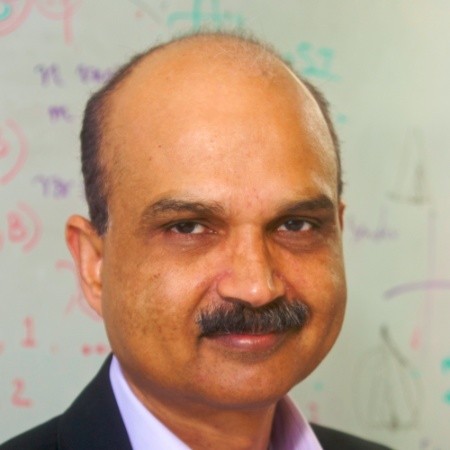
Talk by Ambuj Singh
Title: Symmetry, Representation and Drug Discovery
Abstract:
Pretrained chemical language models embed molecules in high-dimensional spaces whose geometry reflects the Linear Representation Hypothesis (LRH). When the input molecules have a heterogeneous mixture of symmetries, the representations decompose into incoherent subspaces. This enables precise, locally linear control in which subspace-specific steering vectors superpose into a single global direction that can generate molecules with desired properties without retraining or fine-tuning. This method is validated on multiple chemical datasets (QM9, ZINC250K, MOSES, ChEMBL) and multiple properties (QED, SA, LogP), demonstrating reliable and interpretable control of the chemical space. The work offers insights into how symmetries are learned in LLMs.
Speaker Bio:
Ambuj K. Singh is a Distinguished Professor of Computer Science at the University of California, Santa Barbara, with a part-time appointment in the Biomolecular Science and Engineering Program. He received a B.Tech. degree from the Indian Institute of Technology, Kharagpur, and a PhD degree from the University of Texas at Austin. His research interests are broadly in the areas of machine learning, network science, and chemistry/biology. He has published about 300 technical papers over his career. He has led several multidisciplinary projects including UCSB’s Information Network Academic Research Center funded by the Army, Interdisciplinary Graduate Education Research and Training (IGERT) program on Network Science funded by the NSF, and the Multidisciplinary University Research Initiative (MURI) on Network Science of Teams funded by the US Army. His research has also been funded by the National Institute of Health and the Defense Threat Reduction Agency. He has graduated over 60 graduate students over his career, including
- 25 - 25 March,2026
- 05:00 pm - 06:00 pm
- 99C, ScAI Committee Room #502, 5th floor