

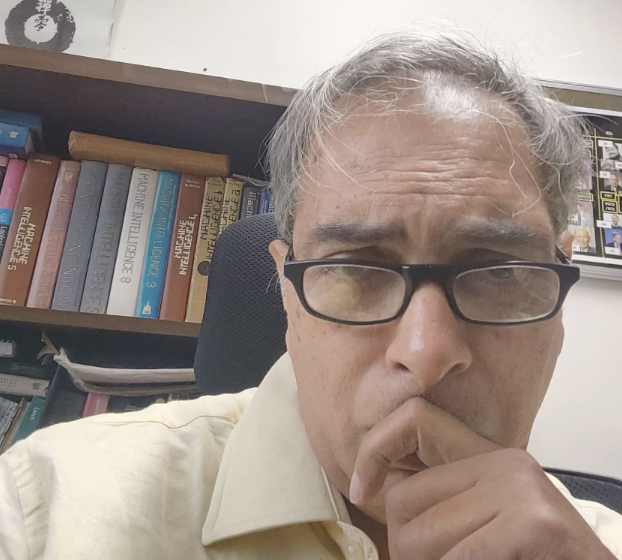
Talk by Prof. Ashwin Srinivasan
Title: Intelligibility in the Time of Clever Machines
Abstract:
Reports suggest that Turing's Test for intelligent machines "has been passed for the first time" at least 3 times in the past decade. We now face the real threat that the progress that has led to success in the Imitation Game--along with a host of other long-standing AI challenges--can be used straightforwardly into finding new ways to fool us. On the positive side, it is also thought that these same machines are now "intelligent enough" to greatly improve our scientific understanding and our engineering capabilities. Here matters are less clear. So far, our progress in these areas has involved a combination of human creativity, along with mathematical and experimental verifiability. While modern-day deep learning programs do appear to construct complex internal representations to assist in their computation, it is unclear whether these representations refer to conceptual structures we know, or correspond to new ones we can understand and use. In such a situation, machine-constructed insights--if any--will remain a closed book to us. Assuming we will not be content with a peripheral role in future scientific and engineering progress, we need to focus on how we can interact intelligibly with such machines. This intelligibility has to work both ways: what we know and need will have to be conveyed usefully to the machine, and what the machine has discovered or created needs to be conveyed meaningfully to us. Although I do not see the ability to interact intelligibly as a property of intelligence--it seems to be more one of communication--we are nevertheless in a time of machines that are clever enough to pass Turing's test (one more time!), but not clever enough to convey what they know (figuratively speaking). Feigenbaum's Bottleneck appears to have resurfaced, only in reverse.
Speaker's Bio
Ashwin is a Senior Professor at the Dept. of Computer Science and Information Systems at BITS Pilani, Goa. He received his Ph.D. in 1991 from the School of Electrical Engineering and Computer Science, the University of New South Wales. In 1991, Ashwin joined the Inductive Logic Programming (ILP) group at the Turing Institute, Scotland and worked on the development and application of Inductive Logic Programming. From 1993--2003, Ashwin was at the Oxford University Computing Laboratory as a post-doctoral researcher, then the Nuffield Trust Research Fellow in Medical Mathematics and finally as a University Lecturer in Computation. In 2003, he moved to the IBM Research – India, as a Research Staff Member. In 2009, he was awarded a Ramanujan Fellowship by the Department of Science and Technology of the Government of India. In 2010, he took up the post of Professor at the newly formed South Asian University, and became the founder Dean of the Faculty of Mathematics and Computer Science. He was Professor of Computer Science at the IIIT-D from 2012, and moved in Jan 2015 to BITS-Pilani, Goa as Chair Professor. From 2020--2023, he was the Head of the Anuradha and Prashant Palakurthi Centre for Artificial Intelligence Research (APPCAIR) at BITS. His main research interest is in the application of AI for Science, using techniques from symbolic and neurosymbolic machine learning.
- 31 - 31 October,2025
- 05:00 pm - 06:30 pm
- LH 310